The University of New Brunswick, in Atlantic Canada, is the oldest English-language university in Canada, and among the oldest public universities in North America.
The university’s Ocean Mapping Group was established in 1991 in response to a national need to develop advanced ocean mapping capabilities. The research of the Ocean Mapping Group is focused on developing new and innovative techniques and tools for the management, processing, visualization and interpretation of ocean mapping data.
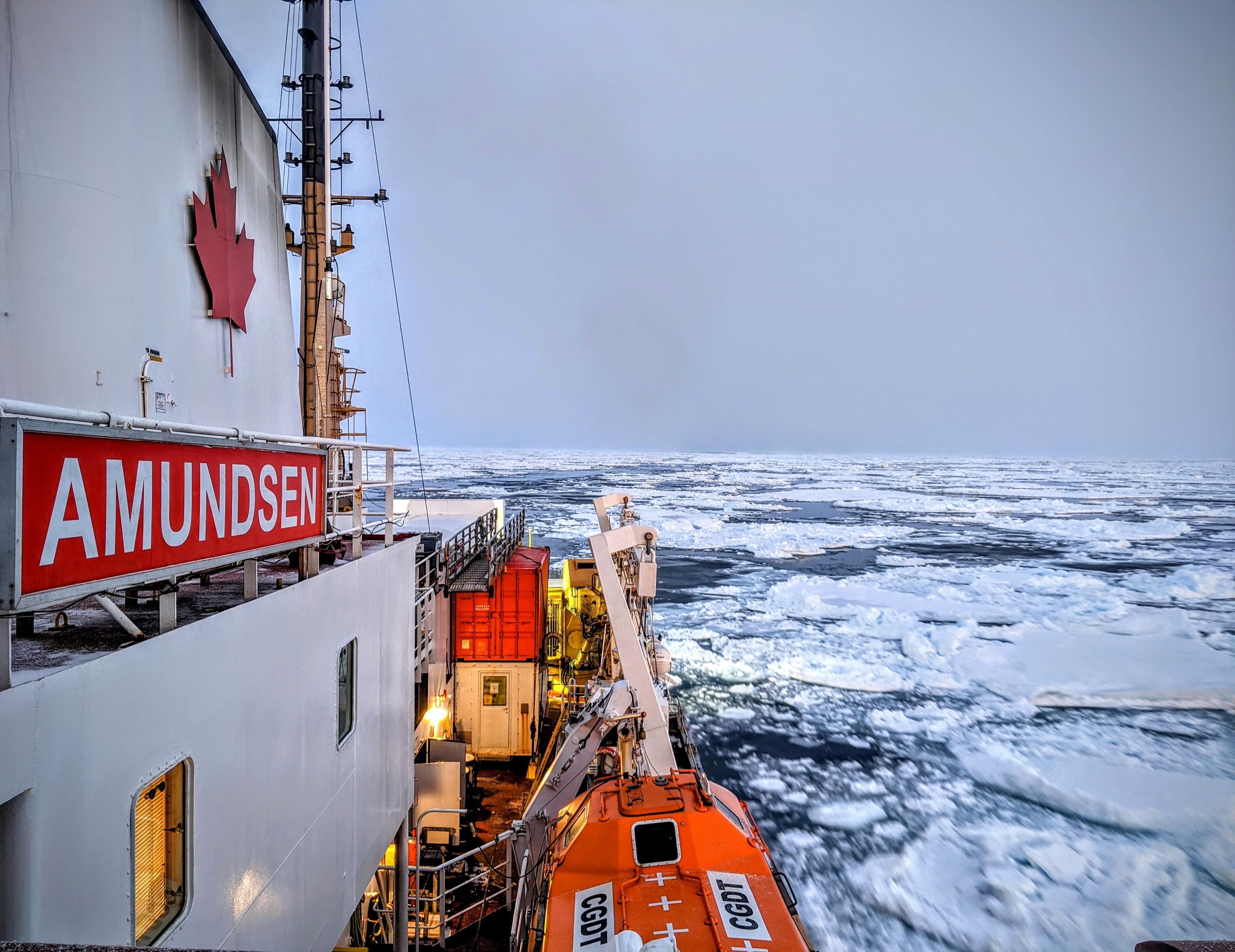
As part of a research partnership exploring Canada’s Arctic, Trimble and the University of New Brunswick joined the CCGS Amundsen, an ice breaker and Arctic research vessel operated by the Canadian Coast Guard and supporting a mapping expedition of the Canadian Arctic coordinated by Amundsen Science.
Unparalleled accuracy in the Canadian Arctic
With a rise in marine traffic as a result of diminishing sea-ice cover in the region, the need to understand and map the area is increasingly important.
Data collected from the lengthy transits and planned surveys allow scientists, hydrographers and the general community to understand the Arctic seabed morphology better and improve navigational safety. Historically, the scientists on the CCGS Amundsen rely on uncorrected, real-time GNSS positioning for data, which is then used by the Canadian Hydrographic Service to be added to charts of Canada’s north.
Due to the length of expeditions — on avareage lasting 110 days — post-processing the positioning data was not feasible. This made real-time corrections a priority for improving positioning data. Precise positioning data is critical when mapping the seafloor and results in improved safety, not only for the vessel and its passengers but also for the surrounding environment and the research itself.
With its reliance on real-time GNSS positioning for data, the CCGS Amundsen is working with only half a meter accuracy. Graham Christie, a researcher in the ocean mapping group at the University of New Brunswick, was interested in testing whether Trimble® CenterPoint® RTX correction service can deliver better accuracy so far north.
Christie recognized the value more accurate data can bring, “Accessing the best positioning data we can gather in real-time is incredibly important. The data is provided to the Canadian Hydrographic Service, and it’s one of the only sources used for ocean mapping as well as for maritime safety when navigating these waters.”
Access beyond the Arctic Circle
In Fall 2022, a member of the University of New Brunswick’s ocean mapping group set off on the CCGS Amundsen on an expedition in the northern reaches of the Canadian Arctic, supported by ArcticNet, a Network of Centres of Excellence of Canada. The ship cruised north of the Arctic Circle, primarily in the open ocean.
At first, onboard scientists were skeptical of whether CenterPoint RTX correction service would work in the far reaches of the Arctic Circle. As they sailed on their journey, CenterPoint RTX proved both reliable and accurate.
“Despite the high latitudes at which this test occurred, the reliability of the correction service over the L-band was remarkably consistent. We were shocked the CenterPoint RTX corrections service kept working as far north as it did. With the exception of when we were deep inside the fjords with mountains on both sides, the correction data was reliable, regardless of our extreme latitude. Typically, there are very few options that far north due to the position of the satellites.” — Graham Christie, researcher at the University of New Brunswick.
Conducting critical science operations in the high Arctic requires robust, reliable systems that are dependably accurate. With a mission specifically envisioned to test the limits of Trimble CenterPoint RTX corrections, the system proved to exceed expectations.
More accurate data for hydrographic and scientific purposes
The communities in this area have very limited roads, and most goods and services arrive by plane or sea. With highly accurate positioning data, especially within the shallow areas around these communities, with an accuracy within 3.5 cm RMS (outside of the published coverage area). CenterPoint RTX correction service greatly improves the accessibility to these communities.


